


EPRC e-library
August 2024
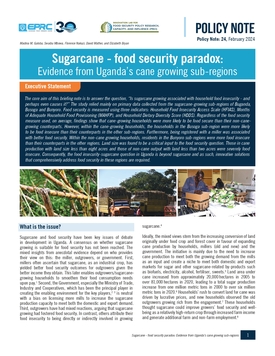
Sugarcane - Food Security Paradox: Evidence from Uganda’s Cane Growing Sub-Regions
The core aim of this briefing note is to answer the question, “Is sugarcane growing associated with household food insecurity – and perhaps even causes it?” The study relied mainly on primary data collected from the sugarcane-growing sub-regions of Buganda, Busoga and Bunyoro. Food security is measured using three indicators: Household Food Insecurity Access Scale (HFIAS), Months of Adequate Household Food Provisioning (MAHFP), and Household Dietary Diversity Score (HDDS). Regardless of the food security measure used, on average, findings show that cane-growing households were more likely to be food secure than their non-cane growing counterparts. However, within the cane-growing households,...
Read More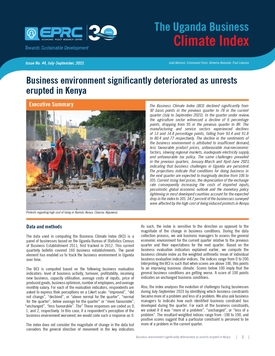
April 2024
Business environment significantly deteriorated as unrests erupted in Kenya
The Business Climate Index (BCI) declined significantly from 92 basis points in the previous quarter to 78 in the current quarter (July to September 2023). In the quarter under review, the agriculture sector witnessed a decline of 6 percentage points, dropping from 95 in the previous quarter to 89. The manufacturing and service sectors experienced declines of 13 and 14.8 percentage points, falling from 93.4 and 91.8 to 80.4 and 77 respectively. The decline in the sentiments of the business environment is attributed to insufficient demand, less favourable product prices, unfavourable macroeconomic factors, slowing regional markets, inadequate electricity supply, and unfavourable tax policy. T...
Read More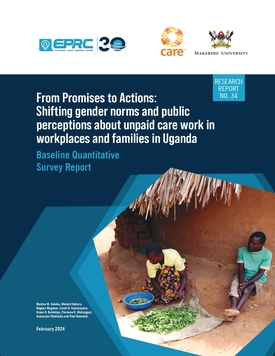
February 2024
From Promises to Actions: Shifting gender norms and public perceptions about unpaid care work in workplaces and families in Uganda: Baseline Quantitative Survey Report
Social and Gender Norms (SGNs) and unpaid care work are intrinsically linked. Global perceptions of SGNs have evolved with globalisation but remain entrenched in most societies at varying levels. The SGNs (Box 1) continue to shape unpaid care work. The 2030 Sustainable Development Goals (SDGs) demonstrate a need to address the negative SGNs that continue to derail women’s and girls’ progress in the world of work. SDG 5 target 5.4 recognises unpaid care and domestic work and calls explicitly to monitor the time spent on unpaid work (United Nations, 2030).
Read More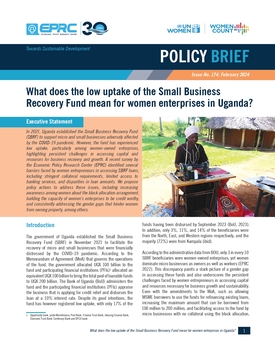
February 2024
What does the low uptake of the Small Business Recovery Fund mean for women enterprises in Uganda?
In 2021, Uganda established the Small Business Recovery Fund (SBRF) to support micro and small businesses adversely affected by the COVID-19 pandemic. However, the fund has experienced low uptake, particularly among women-owned enterprises, highlighting persistent challenges in accessing capital and resources for business recovery and growth. A recent survey by the Economic Policy Research Center (EPRC) identified several barriers faced by women entrepreneurs in accessing SBRF loans, including stringent collateral requirements, limited access to banking services, and disparities in loan amounts. We propose policy actions to address these issues, including increasing awareness among women abo...
Read MoreRecent Publications
Find the latest about Economic Policy Research Center
Forthcoming Publications
October 2023
How can renewable energy development trigger violent conflict in Uganda?
Renewable energy consumption and production are rising across African countries, and Uganda is no exception. Uganda relies on a mixture of sources to meet the energy needs of its population. According to the World Bank, less than half (42%) of the Ugandan population has access to electricity. As a result, most Ugandans rely on biomass to meet their daily energy needs. Electricity generation has historically been based primarily on hydropower and remains so due to its large riverine resources (including the Nile River). The government’s Renewable Energy Policy of 2007 and its 2022 Energy Policy both prioritize increasing the country’s use of renewable energy sources. U...
Read More
May 2023
Skilling Uganda’s youth for the fourth industrial revolution
The Global South is home to 90% of young people worldwide, and by 2030 young people will make up almost half of Africa’s population (El Habti, 2022; GCA, 2021). This youth bulge is an opportunity for Global South countries to take advantage of a larger pool of potential workers to foster economic development. However, limited access to quality education, skills training, and economic opportunities limit the ability of Global South countries to harness this youth bulge (UNDESA, 2015; Gage, 2018). In fact, over 70 million youth globally are unemployed, with young people in the Global South twice as likely to be unemployed or underemployed as compared to the Global North (D’Al...
Read More
February 2024
What does the low uptake of the Small Business Recovery Fund mean for women enterprises in Uganda?
In 2021, Uganda established the Small Business Recovery Fund (SBRF) to support micro and small businesses adversely affected by the COVID-19 pandemic. However, the fund has experienced low uptake, particularly among women-owned enterprises, highlighting persistent challenges in accessing capital and resources for business recovery and growth. A recent survey by the Economic Policy Research Center (EPRC) identified several barriers faced by women entrepreneurs in accessing SBRF loans, including stringent collateral requirements, limited access to banking services, and disparities in loan amounts. We propose policy actions to address these issues, including increasing awareness among women abo...
Read More
October 2023
How can renewable energy development trigger violent conflict in Uganda?
Renewable energy consumption and production are rising across African countries, and Uganda is no exception. Uganda relies on a mixture of sources to meet the energy needs of its population. According to the World Bank, less than half (42%) of the Ugandan population has access to electricity. As a result, most Ugandans rely on biomass to meet their daily energy needs. Electricity generation has historically been based primarily on hydropower and remains so due to its large riverine resources (including the Nile River). The government’s Renewable Energy Policy of 2007 and its 2022 Energy Policy both prioritize increasing the country’s use of renewable energy sources. U...
Read More
February 2024
What does the low uptake of the Small Business Recovery Fund mean for women enterprises in Uganda?
In 2021, Uganda established the Small Business Recovery Fund (SBRF) to support micro and small businesses adversely affected by the COVID-19 pandemic. However, the fund has experienced low uptake, particularly among women-owned enterprises, highlighting persistent challenges in accessing capital and resources for business recovery and growth. A recent survey by the Economic Policy Research Center (EPRC) identified several barriers faced by women entrepreneurs in accessing SBRF loans, including stringent collateral requirements, limited access to banking services, and disparities in loan amounts. We propose policy actions to address these issues, including increasing awareness among women abo...
Read More
May 2023
Skilling Uganda’s youth for the fourth industrial revolution
The Global South is home to 90% of young people worldwide, and by 2030 young people will make up almost half of Africa’s population (El Habti, 2022; GCA, 2021). This youth bulge is an opportunity for Global South countries to take advantage of a larger pool of potential workers to foster economic development. However, limited access to quality education, skills training, and economic opportunities limit the ability of Global South countries to harness this youth bulge (UNDESA, 2015; Gage, 2018). In fact, over 70 million youth globally are unemployed, with young people in the Global South twice as likely to be unemployed or underemployed as compared to the Global North (D’Al...
Read More